


Why are dental implants so expensive?
Chances are, you never realised just how valuable your teeth were until one or more became damaged or lost.
As such, replacing numerous and complex parts of the body is unlikely to be cheap, given all of the things teeth have to do.
But why exactly do dental implants cost more?
Are dental implants expensive?
Every human on the planet is born with the ability to generate two sets of teeth, one set develops while in the womb and the other set is created during early childhood.
Our mouths and teeth help us to do many things, in addition to biting, tearing, chewing, releasing the nutrients from food, and making it digestible in the stomach. These include helping us to:
- Form and speak words and sing
- Produce facial expressions
- Create the regular shape of the face
- Shape how others see us
- Raising our self-esteem
- Protect our general health
How much do you think these abilities are worth?
With these things in mind, why is the dental implant cost in London, or in other cities, not as high as you might think?

Teeth that stand the test of time
Choosing dental implants is the ultimate solution for those living with tooth loss. They can last for many decades to come, as long as:
- The patient has a stable medical history
- There is a good amount of gum and bone structure within the mouth
- The other teeth are healthy
- Dental hygiene is maintained
Ongoing studies have shown that dental implants, when fitted and cared for well, are lasting up to 30-35 years or more – giving patients incredible value for money, as the price per year continually decreases.
Similarly, as longer-lasting solutions, patients will save money versus non-permanent solutions, like implant supported bridges, which will need replacing as the years go on.
Teeth constructed from high-quality materials
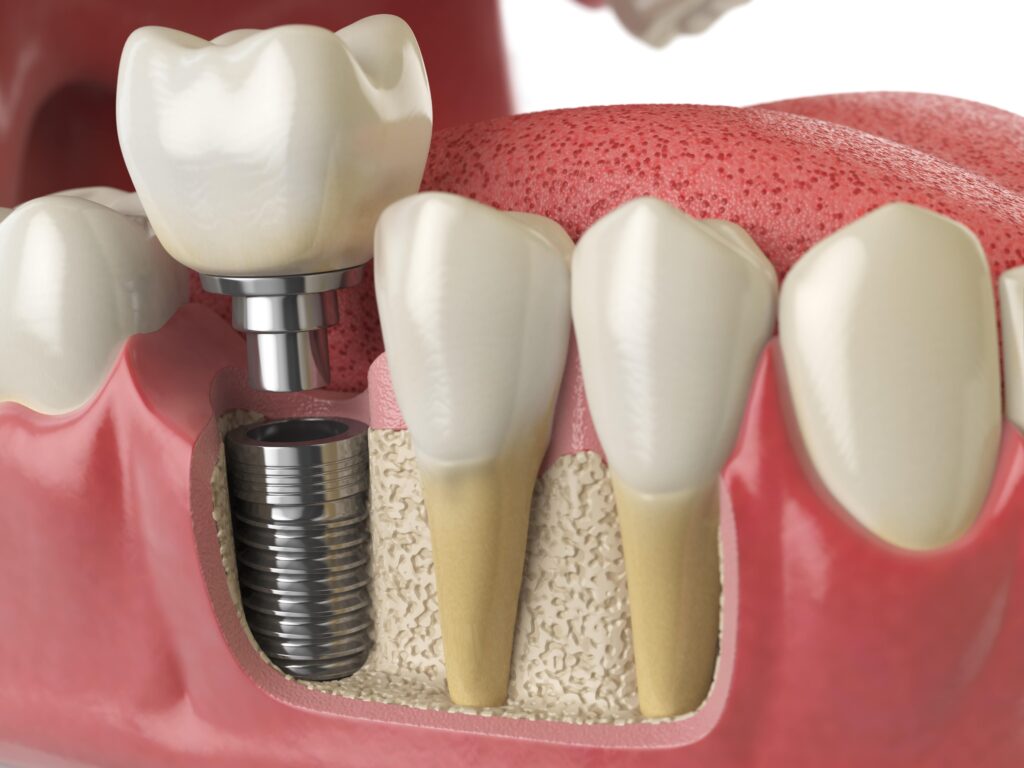
All 3 parts of dental implants are constructed from medical-grade materials already proven to stand the test of time and successfully replace human body parts. Our chosen brand partner is Straumann, developer of the groundbreaking Roxolid™ material.
The implant and abutment, which replaces the roots and neck of natural teeth, are constructed from a bespoke mix of zirconium and titanium – its biocompatible qualities aid with osseointegration.
Biocompatibility is essential for dental implants and prosthetic limbs alike, as they can be placed within the structure of the body without causing harm and work in harmony with existing natural structures.
Titanium also encourages osseointegration. This is the process of fusing between the implant and the body, in which bone is rebuilt and bonds securely with the structures of the implant – helping to create a secure connection to the jawbone.
These materials have been used for decades to provide artificial limbs or prostheses for amputees and to replace worn knee and hip joints.
The topping dental crown that replaces the crown of a natural tooth can be manufactured from a range of metals and composites, including porcelain, ceramic, zirconium, and acrylics.
This gives them the ability to withstand the pressure and action of chewing without damage and ensures they look just like regular teeth for years to come.
The quality of the materials used in dental implant technology ensures that dental implants last far longer than other tooth-replacement options, giving them excellent value for money.
Correctly positioned teeth
The importance of the position and shape of the teeth in the mouth cannot be overlooked, for ensuring the bite is aligned, creating a symmetrical smile, and making sure the dental implants are secure.
When replacing lost teeth with dental implants, the same is true.
Your dentists will spend time when you are not present carefully planning your procedure using a range of scans, including CT scans, to ensure the dental implant roots are positioned correctly – providing maximum bite strength, easy chewing, and a beautiful smile.
They will also ensure that the shape and appearance of the teeth match the lost teeth, filling in the gaps seamlessly. Sharper-angled incisors and canines at the front of the mouth help with biting and tearing food, and the larger, flatter pre-molars and molars that chew, crush, and grind the food, will be delicately crafted and coloured to mimic your natural teeth.
This attention to detail means that not only will your dental implants be in the most natural position, but they will look and feel just like your natural teeth did too.
Choose MIC for dental implants in the capital
While dental implant costs in London are always likely to be considered an investment, we hope you now understand how much time and craftsmanship goes into fitting your brand new smile.
Can you really put a price on the freedom to enjoy a full and varied diet, speak confidently, and smile with confidence once more?
To contact MIC to set up a dental implant consultation, press the blue Book an Appointment button at the top of your screen, give us a call on 020 34 34 29 34, or send us an email and we’ll get back to you to get the process started.